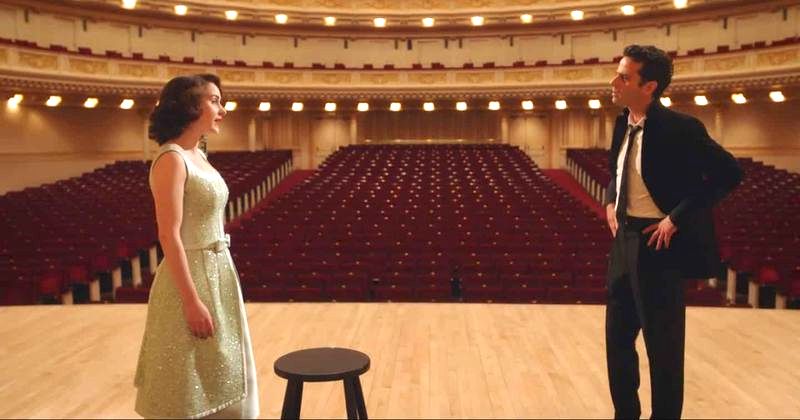
Watching: Lenny and Midge

The Marvelous Mrs. Maisel is one of the best shows on television right now, and the Season 4 finale delivered one of the most riveting scenes yet in the story of a woman trying to crack the world of standup comedy in the late 1950s/early 1960s.

The rest of this post has spoilers — it’s about what happens in Season 4, Episode 8. First and last warning.

Mrs. Maisel has joined 3,000 other crazed souls who braved a February 1961 snowstorm to attend the historic Carnegie Hall appearance by her friend (and now lover) Lenny Bruce. Lenny had to turn down a five-night job at the Copacabana opening for Tony Bennett, and he told the singer’s people that they should hire Mrs. Maisel instead.

But Midge has a new rule: She’s not going to be anyone’s opening act. Having been fired on the tarmac just before her tour with Shy Baldwin was about to take off at the end of last season, she got a job as hostess at a strip club (such establishments were illegal in 1961) where she can do her act the way she pleases.

After his triumphant appearance, Lenny takes her onto the stage of Carnegie Hall, and while she’s basking in the vicarious glow of what it must have felt like, he confronts her about turning down the Tony Bennett opportunity.

Don’t put me on a pedestal, he says, take the opportunities that are presented to you.

“You’re not going to get here hiding yourself in a club that technically doesn’t exist,” he pleads.

“So I’m just supposed to go get fired from one job after another,” Midge says scornfully.

“Yes. If that’s what it takes.”

Lenny tells her 90% of getting to Carnegie Hall is building the perception that you belong there.

“They see you hanging with Tony Bennett they think you deserve to be there,” he shouts. “They see you hauled off to jail for saying ‘fuck’ in a strip club they think you deserve that also. Wise up.”

“I’m not hiding,” she says, a little less certainly. “I have a plan.”

“Don’t plan! Work! Just work and keep working,” and he makes his final argument: “There is a moment in this business; windows open. If you miss it it closes. Just don’t —“ and there’s a dramatic pause as Lenny tries to keep his composure. “If you blow this, Midge, I swear …” and he walks off the stage … “You will break my fucking heart.”

Rachel Brosnahan as Midge, and Luke Kirby as Lenny Bruce, play this powerful scene to perfection. These are two likable train wrecks, and since Lenny Bruce was real, we know he’s heading for a tragic end. To see him pleading with Mrs. Maisel to learn from his mistakes, not repeat them, well, it was just brilliant theater.

But more important, it conveys tremendously sound advice from the mouth of this tragically doomed entertainer, at the apex of his own career. Making your dreams come true takes hard work and taking advantage of opportunities when they present themselves, and when a window opens, you’d better be prepared to climb in.

I understand the fifth season of The Marvelous Mrs. Maisel will complete the story, which makes me sad to know this terrific ensemble cast will only be delivering eight more episodes, but they’ve set the stage for them to be eight astounding hours. I’m very much looking forward to seeing Mrs. Maisel go forward. 

The Legacy

Photo  © Danciaba | Dreamstime.com

There was this boy who sat cross-legged and invented superhero stories and wrote songs, and all just for the fun of it. Maybe he dreamed of a world when the world would reward him with a house on a hill and a good woman and happily ever after, but mostly he immersed himself in the story and the lyrics and the imaginary world of it all.

One day he was old enough that he had to decide how he was going to feed himself, and he knew it would be with the words, and he spent years and years and years sending words into the ether and onto newsprint pages, humming the songs all along the way and dreaming of the old stories.

The end of the road was not quite in sight, but it may have been over the crest of the next hill or a few dozen hills beyond that, and still he was dreaming about that other path, the one with the stories and songs, and when he was weary of second-guessing, he said, “I’m just going to do it, here I go now, I’m going to write what I always wanted to write, here it all comes world, here I come.” 

Nothing happened at first, and he worried that’s how the world would find him, crouched down to take the leap and never having leaped. But then he started jumping and walking and running and sprinting, and the words — oh, the words! — they flooded the page with energy and pith and vinegar, and he didn’t care if the world noticed, but he wanted the world to see what it could be if it only embraced the joy and the feeling of wow-isn’t-it-a-marvelous-gift-to-be-alive?

The world watched him sprint by and looked at one another and said, “Oh, bother, there goes another one, when will they ever learn?” But over here, and over there, and perhaps there on the side, one by one others looked the way he’d gone and took a step, and then another step, until they discovered the joy and bells rang and shouts shouted, and soon a small crowd was jumping and dancing and screaming “joy!” to the world.

Something began to soften in the heart of the world, maybe not in a lifetime but over there on the horizon where they saw a hope of a better world where joy was more common than sorrow and where puppies and kittens can come out to play and be free.

“Be free!” he called as he flew out of sight. “Love one another and lose the shackles of darkness and anger and hate. The love and the joy will lift us all to the sky so we can live. Understand this above all, oh, please open your eyes and see the world that could be — Make it the world we all know and leave the madness behind. Please, oh, please do this for one another and yourselves …”

Once he was gone, his words echoed in their minds like the memory of the most powerful exhilaration anyone had ever known. And first one person, then another, set down their weapons and worries and saw each other for the first time.

And on everyone’s lips was a smile and a question: “Wow. Isn’t it a marvelous gift to be alive?”

Professionals ship on time

Then there are the days when the words gallop into existence, as opposed to the days when the words trickle out in a crawl.

That, I suspect, is the difference between an amateur and a pro.

In the day job when the words are due, you just turn the spigot and out they flow. If you want to be a professional author, then author-type words need to flow when you turn the spigot.

A professional may write “when the mood strikes,” but he makes damn sure that the mood strikes when it’s time to get to work.

If your business is words, you need to ship words when you say you will.